Tuesday, July 23, 2013

Analysis Cannot Answer the Question “Why”


One of the really great things we do in Business School is to teach students an abundance of analytical tools.

There’s the basic SWOT analysis – what are your strengths, weaknesses, opportunities, threats?

And there’s . . .

Scenario Planning – let’s forecast the possible futures.

Balanced Scorecard – how can we predict future performance by tracking metrics in various operational areas?

The 7S Model of Strategy Implementation – thanks McKinsey.

And most elegantly, Porter’s Five Forces.  I don’t think I can observe an afternoon of presentations by our Executive MBAs without at least one of them working in Porter’s Five Forces.  If you don’t know them, check them out here.

As helpful as these analytical tools are, there is one thing they cannot do for you.  They cannot answer the question “Why?”  They cannot tell you “why” or “why not” you should do something.

Some of the most interesting and important questions of an individual’s or organization’s life, are “why” questions.

Why are we here?

Why is this important?

Analysis can’t tell you your values, your passion, or what you should care about.

The next time you see your team heading down a rabbit hole toward some decision to be made among uninteresting alternatives, you might ask them: “Hey guys, why again are we thinking about doing this?  Why do we care about this?  Let’s get back to the basics.”  Those can be some pretty powerful “why” questions.

Once you know “why,” then those analytical tools can be very helpful in figuring out how and what and where and when.  But if you don’t know “why,” then those really don’t matter.

*The blog title is a quote by the great Systems Thinking pioneer, Dr. Russell Ackoff.  Thanks Russ!


For more ideas on how you can lead breakthroughs in your organization, follow this blog and check out my web site at www.SheehanNonprofitConsulting.com   You will find free resources you can download, including a Breakthrough Strategy Workbook that you can download at no cost.  You can also check out my book, Mission Impact:  Breakthrough Strategies for Nonprofits, and buy it if you are interested.  And you can follow Sheehan Nonprofit Consulting on Facebook.

Thursday, July 11, 2013

"Nice Guys" Finish . . .


Which group is least successful in their work life?

“Givers” who are characterized by being helpful, compassionate, caring, and kind?

Or

“Takers” who are always looking out for what is best for themselves?

It turns out that “Givers” make up this least successful group.

And the most successful?

“Givers” as well!

What’s going on here?

It turns out that some “Givers” have learned how to leverage their helpfulness in a way that is good for others and for themselves:  win-win behaviors.  But other “Givers” are unable to protect themselves from being taken advantage of or otherwise protecting their own interests.

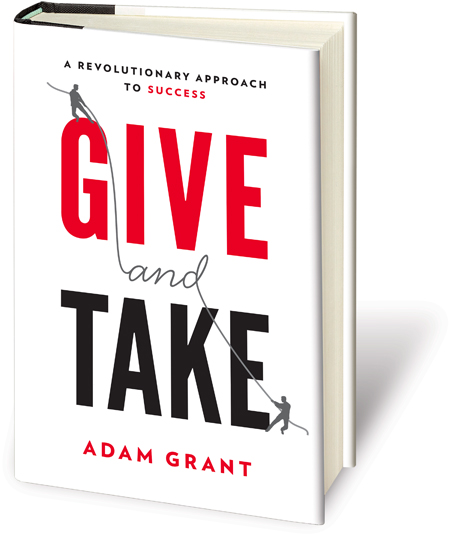
Dr. Adam Grant, a professor at the Wharton School of Business, reports on this in his excellent new book, Give and Take.  It is exceptionally well written with cutting edge research that is woven into colorful stories which illuminate his points.

I strongly recommend this book, especially to my nonprofit executive brothers and sisters – many of whom I know fall into this “Giver” category.  Dr. Grant has very helpful, practical advice on how “Givers” can use their natural giving tendencies to enrich their social networks, leverage their giving nature, and be even more successful. 

More importantly, he gives advice on how to avoid the pitfalls of being a “Giver.”  For example, in his chapter “Chump Change” he tells stories of “Givers” who have learned how to be more effective negotiators (e.g., salary negotiations!).  They have changed and are no longer chumps!  He also provides important advice on avoiding "Giver" burnout – a major challenge for nonprofit execs.  The “Giver” nature of so many nonprofit executives is a wonderful part of our culture – but not to the point that it hurts you. 

Learn how to be a more effective “Giver” so you can take care of yourself while also making a Mission Impact.


For more ideas on how you can lead breakthroughs in your organization, follow this blog and check out my web site at www.SheehanNonprofitConsulting.com   You will find free resources you can download, including a Breakthrough Strategy Workbook that you can download at no cost.  You can also check out my book, Mission Impact:  Breakthrough Strategies for Nonprofits, and buy it if you are interested.  And you can follow Sheehan Nonprofit Consulting on Facebook.
Tuesday, July 2, 2013

The Performance Paradox

Yes!  I want to be a high performer!

Yes!  I want to accomplish all of my goals!

Sorry.  You can’t have it both ways.

What!?!  Why?

While it may seem like a contradiction – the only way to maximize your performance is to give up your desire to attain your goals 100%.

Research on goals shows that the higher you set your goals, the greater performance you will have.*  So, if you want to be a high performer you need to set high goals.

But, the higher you set your goals the greater chance you have of falling short of them.

You need to choose.  What will it be – Performance or Goal Attainment?

High performers know that it is smart to set huge goals.  They use the goals to inspire them to higher levels of performance.  But they care a lot more about their actual performance than whether they completely meet the goal.  The goal is simply a mechanism to help them achieve higher levels of performance.

You can read more about all of this in my article, The Power of Goals.

What will you choose?

I hope you choose Performance.  If you do, you can make a Breakthrough Mission Impact for those you serve.


*A Theory of Goal Setting & Task Performance, by Edwin Locke and Gary Latham, 1990.

For more ideas on how you can lead breakthroughs in your organization, follow this blog and check out my web site at www.SheehanNonprofitConsulting.com   You will find free resources you can download, including a Breakthrough Strategy Workbook that you can download at no cost.  You can also check out my book, Mission Impact:  Breakthrough Strategies for Nonprofits, and buy it if you are interested.  And you can follow Sheehan Nonprofit Consulting on Facebook.

Thursday, June 20, 2013

Management via Panic

I knew a manager once who liked to start the day with her team by saying “What’s on fire!?!”  It was said enthusiastically, expectantly – almost hopefully.

There is a certain “jazz” that some people get from addressing an “emergency” situation.  But trying to “motivate” your team on a regular basis by inflicting panic on them is not a winning management style.

Unless you work in a real ER, then your “normal” days should not be filled with managing one panic situation after another.  If there is too much panic in your work life, then here are some possible causes and solutions:

*Over-reacting to non-urgent issues.  People will bring you issues that they think are urgent.  Don’t fall for this every time.  Take a few minutes to carefully evaluate the situation.  Many times the best response is “I understand, but this can wait.”  Sometimes these issues actually resolve themselves in time.


*Poor systems & SOPs.  This is such a common problem and takes discipline to fix.  Budget time to create Standard Operating Procedures and train staff on them.  Common breakdowns in the system need to be studied and addressed with new procedures.  The causes of constant panic are often systemic.

*Panicy Bosses.  You need to learn how to manage your boss.  The first step is having an agreement with your boss on the most important priorities that you should be working on.  When your boss brings you an “urgent” issue, then make sure to respond positively.  But then make sure that she/he understands the tradeoff involved and how it will impact the other work that the two of you agreed was a high priority.  Let’s face it, sometimes you can negotiate this and sometimes you cannot.

The problem with constant “fire drills” is that it does not give us time to give the thoughtful consideration needed to successfully address the significant, thorny challenges that face organizations today.  And it certainly does not provide time for any strategic thinking.

To learn more, a great book on how to devote more of your time to important issues (vs. regular “panic”) is Steven Covey’s First Things First.

Good luck devoting more time to important matters and less to panic!  As you do this you will definitely be making more of a Mission Impact.


For more ideas on how you can lead breakthroughs in your organization, follow this blog and check out my web site at www.SheehanNonprofitConsulting.com   You will find free resources you can download, including a Breakthrough Strategy Workbook that you can download at no cost.  You can also check out my book, Mission Impact:  Breakthrough Strategies for Nonprofits, and buy it if you are interested.  And you can follow Sheehan Nonprofit Consulting on Facebook.

Monday, June 10, 2013

Leadership is Fragile

I am blogging today from Columbus, OH, home of one of my alma maters, The Ohio State University.  Later today I will be doing a one day workshop based on the Mission Impact book entitled “Clearing Hurdles to Innovation & Strategy” for about sixty-five nonprofit executives from Central Ohio.


 Usually when I visit here, the buzz is about football or basketball.  But not today.  The buzz is all about the recent announcement of the retirement of the incredibly popular Ohio State President Dr. E. Gordon Gee.  In case you are one of the few people on the planet who have not heard about the recent controversy surrounding Dr. Gee, negative comments he made about other universities at a meeting of Big Ten presidents and athletic directors back in December recently became public.  Depending on your perspective, the comments were either “unfortunate attempts at humor” or “mean spirited.”  Regardless, they factored into his decision to retire.

Dr. Gee is an incredible leader.  I had the opportunity to meet him when he first became President in September 1990 and I was a Ph.D. student at Ohio State – he is an amazing, charismatic leader.  He has led the university impressively and with impact.  He has thousands of fans in the Buckeye world.  TIME magazine named him the most outstanding President of a university in 2010.

And yet, these comments helped to bring him down.  What can we learn from this?

Leadership is fragile.

I recently read where someone said:

“Every time you do something good as a leader, it’s like you put a pebble in your pocket.  And when you do something bad, you take a pebble out.  As a leader, you need to keep pebbles in your pocket, so people will follow you.”

This advice is incorrect in one important way.  Doing something good, does “give you a pebble.”  But doing something bad can cut your pocket open and all the pebbles will fall out.  We have certainly seen this with other public leaders (e.g., Eliot Spitzer among many others) whose acts are far, far, more egregious than Dr. Gee’s.

If we want to lead others – or causes – we need to be ever vigilant to monitor our behaviors and censor actions which can cause the loss of our credibility.  Otherwise, we will be unable to help make the Mission Impact to which we are committed.  Leadership is fragile.


For more ideas on how you can lead breakthroughs in your organization, follow this blog and check out my web site at www.SheehanNonprofitConsulting.com   You will find free resources you can download, including a Breakthrough Strategy Workbook that you can download at no cost.  You can also check out my book, Mission Impact:  Breakthrough Strategies for Nonprofits, and buy it if you are interested.  And you can follow Sheehan Nonprofit Consulting on Facebook.