Wednesday, August 21, 2013

What is Strategy?


Strategy is an integrated explanation of how an organization is going to guide its performance into the future.

That’s my basic definition.  This is the beginning of a blog series that will elaborate on this definition.  Let’s start with the big picture first.

I have reviewed hundreds of “strategic planning” documents from organizations.  And most of them don’t include much “strategy."  I have found that most organizations have lots of plans and activities in these documents, but very little strategy.

If you ask an organization (in any sector -- corporate, government, not-for-profit) for their strategy, then what you usually get is a collection of disconnected goals or initiatives.  Sometimes you get spreadsheets with revenue projections.  These are not a strategy!


Here’s the bottom line.

A strategy needs to provide high level direction to an organization on how it will guide its performance into the future – how it will accomplish its mission.  It does not provide “action plan” level details.  It provides “themes” that will be followed in the coming years.

A few years ago, Collins & Rukstad had this to say about strategy in an article they wrote in the Harvard Business Review*:  

“Leaders of firms are mystified when what they thought was a beautifully crafted strategy is never implemented. . . .  They fail to appreciate the necessity of having a simple, clear, succinct strategy statement that everyone can internalize and use as a guiding light for making difficult choices.”

That’s what a strategy is – a simple, clear, succinct statement.  Stay tuned to learn more about how to develop a strategy that will guide your organization toward Breakthroughs in your Mission Impact.


*"Can You Say What Your Strategy Is?" Harvard Business Review, April, 2008.

For more ideas on how you can lead breakthroughs in your organization, follow this blog and check out my web site at www.SheehanNonprofitConsulting.com   You will find free resources you can download, including a Breakthrough Strategy Workbook that you can download at no cost.  You can also check out my book, Mission Impact:  Breakthrough Strategies for Nonprofits, and buy it if you are interested.  And you can follow Sheehan Nonprofit Consulting on Facebook.

Tuesday, August 13, 2013

Pallotta Insights from The Bridge

As reported in my last blog, my friend John Thomas and I facilitated a session on Dan Pallotta’s TED Talk at the recent Bridge Conference.  The participants had such great insights that I asked John to join me as co-author of this week’s blog to provide some of the highlights of those comments.  Thanks John!  Here is our report:

*We – nonprofit executives – need to get better educated about finances and overhead cost arguments.

*The culture supporting low overhead costs is VERY strong among donors and Board members; we have a lot of work to do.

*We also have a lot of work to do among staff.

*We need to change the way we train staff and orient new board members. Training and orientation should flow down from new principles and values – some of which were in the Pallotta talk.

*Putting an “Innovation Fund” line item in the organization budget can help support a culture of creativity and experimentation.

*We are part of the problem in that many of us have bragged about low overhead with simplistic pie charts in reports.  We have to tell more of the story and shift to talking about IMPACT.  We also need new ways of thinking about IMPACT.

*The proliferation of new non-profits creates problems and perhaps it should be harder to start them.  More mergers may be needed.

*Government shrinkage may become an even larger driver of need for effective and efficient NPOs.  Use this change to leverage re-thinking matters of infrastructure, capitalization and compensation for NPOs.  (If the government can move toward privatization of services, why can’t NPOs take on some of these characteristics?)

*We should consider joining the organization Pallotta started, The Charity Defense Council.

*We need to hold our various nonprofit membership groups (e.g., AFP, CASE, AHP, AGB) accountable for fighting The Overhead Myth.  And they need to get connected to The Charity Defense Council.

There you have it!  Thanks to the great folks who turned out for the session and provided these excellent insights.  We have a lot of work to do to combat The Overhead Myth, but Dan Pallotta has provided us with a great conversation starter with his video.  Let’s get to work.


For more ideas on how you can lead breakthroughs in your organization, follow this blog and check out my web site at www.SheehanNonprofitConsulting.com   You will find free resources you can download, including a Breakthrough Strategy Workbook that you can download at no cost.  You can also check out my book, Mission Impact:  Breakthrough Strategies for Nonprofits, and buy it if you are interested.  And you can follow Sheehan Nonprofit Consulting on Facebook.

Thursday, August 1, 2013

Pallotta & The Overhead Myth

You are probably one of more than 2 million people who have viewed Dan Pallotta’s TED Talk “The Way We Think About Charity is Dead Wrong.”  If not, you better get with it!

Tons has been written about this talk.  Pallotta turns some people off, but one thing is for certain – he has gotten people’s attention!

Tomorrow, my friend John Thomas and I are presenting a session on Pallotta’s views here at the largest annual conference for nonprofit executives in the DC area.  More than 1,000 nonprofit professionals are attending The Bridge to Integrated Marketing and Fundraising Conference.  Our session will provide opportunities for dialogue on the five points that Pallotta discusses in his talk.  If you are attending the conference, you need to stop by our session tomorrow (Friday, August 2) at 11:15 a.m.!

Many people have credited Pallotta with inspiring GuideStar, the BBB Wise Giving Alliance, and Charity Navigator to initiate their The Overhead Myth campaign.  As a part of this campaign, they have published an open Letter to the Donors of America.  My favorite part of the letter is the conclusion:  “The people and communities served by charities don’t need low overhead, they need high performance.”  Amen to that!


Can’t attend the conference?  Here are some of my key take-aways:

*As Nonprofit executives we need to be VERY well educated on overhead arguments.  It is not "overhead," it is infrastructure!  We need to know how to engage others about it and make the case.  This is especially true with respect to fundraising costs.

*As a profession, we need to actively denounce the fraudulent outliers.  They are not us!  (Such as America’s Worst Charities as per the Tampa Bay Times.)

*We need to aggressively engage our Board members about these issues so they can become active advocates.

I hope to see you tomorrow at The Bridge!


For more ideas on how you can lead breakthroughs in your organization, follow this blog and check out my web site at www.SheehanNonprofitConsulting.com   You will find free resources you can download, including a Breakthrough Strategy Workbook that you can download at no cost.  You can also check out my book, Mission Impact:  Breakthrough Strategies for Nonprofits, and buy it if you are interested.  And you can follow Sheehan Nonprofit Consulting on Facebook.

Tuesday, July 23, 2013

Analysis Cannot Answer the Question “Why”


One of the really great things we do in Business School is to teach students an abundance of analytical tools.

There’s the basic SWOT analysis – what are your strengths, weaknesses, opportunities, threats?

And there’s . . .

Scenario Planning – let’s forecast the possible futures.

Balanced Scorecard – how can we predict future performance by tracking metrics in various operational areas?

The 7S Model of Strategy Implementation – thanks McKinsey.

And most elegantly, Porter’s Five Forces.  I don’t think I can observe an afternoon of presentations by our Executive MBAs without at least one of them working in Porter’s Five Forces.  If you don’t know them, check them out here.

As helpful as these analytical tools are, there is one thing they cannot do for you.  They cannot answer the question “Why?”  They cannot tell you “why” or “why not” you should do something.

Some of the most interesting and important questions of an individual’s or organization’s life, are “why” questions.

Why are we here?

Why is this important?

Analysis can’t tell you your values, your passion, or what you should care about.

The next time you see your team heading down a rabbit hole toward some decision to be made among uninteresting alternatives, you might ask them: “Hey guys, why again are we thinking about doing this?  Why do we care about this?  Let’s get back to the basics.”  Those can be some pretty powerful “why” questions.

Once you know “why,” then those analytical tools can be very helpful in figuring out how and what and where and when.  But if you don’t know “why,” then those really don’t matter.

*The blog title is a quote by the great Systems Thinking pioneer, Dr. Russell Ackoff.  Thanks Russ!


For more ideas on how you can lead breakthroughs in your organization, follow this blog and check out my web site at www.SheehanNonprofitConsulting.com   You will find free resources you can download, including a Breakthrough Strategy Workbook that you can download at no cost.  You can also check out my book, Mission Impact:  Breakthrough Strategies for Nonprofits, and buy it if you are interested.  And you can follow Sheehan Nonprofit Consulting on Facebook.

Thursday, July 11, 2013

"Nice Guys" Finish . . .


Which group is least successful in their work life?

“Givers” who are characterized by being helpful, compassionate, caring, and kind?

Or

“Takers” who are always looking out for what is best for themselves?

It turns out that “Givers” make up this least successful group.

And the most successful?

“Givers” as well!

What’s going on here?

It turns out that some “Givers” have learned how to leverage their helpfulness in a way that is good for others and for themselves:  win-win behaviors.  But other “Givers” are unable to protect themselves from being taken advantage of or otherwise protecting their own interests.

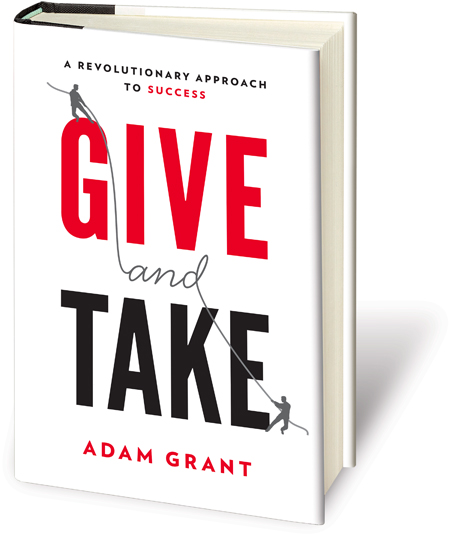
Dr. Adam Grant, a professor at the Wharton School of Business, reports on this in his excellent new book, Give and Take.  It is exceptionally well written with cutting edge research that is woven into colorful stories which illuminate his points.

I strongly recommend this book, especially to my nonprofit executive brothers and sisters – many of whom I know fall into this “Giver” category.  Dr. Grant has very helpful, practical advice on how “Givers” can use their natural giving tendencies to enrich their social networks, leverage their giving nature, and be even more successful. 

More importantly, he gives advice on how to avoid the pitfalls of being a “Giver.”  For example, in his chapter “Chump Change” he tells stories of “Givers” who have learned how to be more effective negotiators (e.g., salary negotiations!).  They have changed and are no longer chumps!  He also provides important advice on avoiding "Giver" burnout – a major challenge for nonprofit execs.  The “Giver” nature of so many nonprofit executives is a wonderful part of our culture – but not to the point that it hurts you. 

Learn how to be a more effective “Giver” so you can take care of yourself while also making a Mission Impact.


For more ideas on how you can lead breakthroughs in your organization, follow this blog and check out my web site at www.SheehanNonprofitConsulting.com   You will find free resources you can download, including a Breakthrough Strategy Workbook that you can download at no cost.  You can also check out my book, Mission Impact:  Breakthrough Strategies for Nonprofits, and buy it if you are interested.  And you can follow Sheehan Nonprofit Consulting on Facebook.